here's another little gem I found on the Osvalve site. a great article on tone stacks. enjoy!
http://www.ozvalveamps.org/tonestacks.htm
Showing posts with label article. Show all posts
Showing posts with label article. Show all posts


14.12.10
ELECTRONICS AUSTRALIA PROJECTS AT OZVALVE AMPS
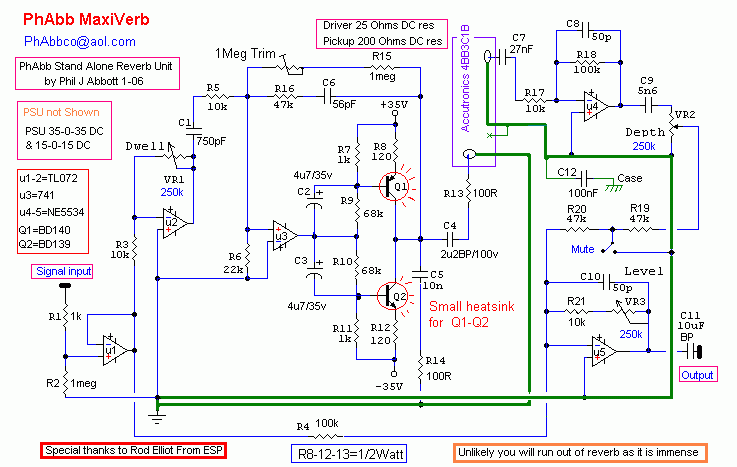
I'm not sure what's up with all these posts about the land down under lately, but I recently ran across THIS great Australian site that has tons of information on Aussie guitar amps as well as building guitar amps and effects. included are a number of old magazine projects from EA. if you scroll down the page, you'll find schematics for fuzz, compressor, "phase vibrato" Leslie sim, and tremolo projects as well as a number amps. be sure to check out the rest of the site, as it's filled with some very cool articles and schematics, such as fsb forumite Phil's cool reverb project.
6.8.10
TROUBLESHOOTING OPAMP CIRCUITS
here's a cool little protocol for troubleshooting opamp circuits for the university of exeter physics department. it should be able to get you out of most opamp entanglements you get yourself into.
http://newton.ex.ac.uk/teaching/CDHW/Electronics2/troubleshooting.html
http://newton.ex.ac.uk/teaching/CDHW/Electronics2/troubleshooting.html
COOL STUFF FROM EE TIMES
here'a some interesting things i found on the ee times site. an interesting article on audio myths, two audio amplifier design articles from john linsley hood's book, and another with a great vintage video of rca tubes being made. very cool stuff!
http://www.eetimes.com/electronics-blogs/audio-designline-blog/4033511/Audio-Myths-Workshop-video
http://www.eetimes.com/design/audio-design/4015905/Discrete-audio-amplifier-basics--Part-1-Bipolar-junction-transistor-circuits
http://www.eetimes.com/design/audio-design/4015906/Discrete-audio-amplifier-basics--Part-2-JFETs-MOSFETs-and-other-circuit-configurations
http://www.eetimes.com/electronics-blogs/audio-designline-blog/4033497/Vacuum-tubes-A-valve-video-a-tube-amp-modeler-and-a-joke
http://www.eetimes.com/electronics-blogs/audio-designline-blog/4033511/Audio-Myths-Workshop-video
http://www.eetimes.com/design/audio-design/4015905/Discrete-audio-amplifier-basics--Part-1-Bipolar-junction-transistor-circuits
http://www.eetimes.com/design/audio-design/4015906/Discrete-audio-amplifier-basics--Part-2-JFETs-MOSFETs-and-other-circuit-configurations
http://www.eetimes.com/electronics-blogs/audio-designline-blog/4033497/Vacuum-tubes-A-valve-video-a-tube-amp-modeler-and-a-joke
NATIONAL SEMI AN-779
national semiconductor application note number 779 is a great resource on active, passive and switched capacitor filters. check it out!
http://www.national.com/an/AN/AN-779.pdf
as a bonus, here is a page on designing state variable filters for audio.
https://pantherfile.uwm.edu/msw/www/StateVariable/index.html
http://www.national.com/an/AN/AN-779.pdf
as a bonus, here is a page on designing state variable filters for audio.
https://pantherfile.uwm.edu/msw/www/StateVariable/index.html
22.7.10
ALL ABOUT CIRCUITS WORKSHEETS
this page from the ALL ABOUT CIRCUITS website has a multitude of worksheets for the electronic diyer to learn from and test themselves with.
http://www.allaboutcircuits.com/worksheets/index.html
there is everything from AC, to DC, to FETs, opamps, filters, and BJTs. even such simple stuff as ohm's law and caps and resistors. seriously, everything from atoms to active circuits!
for example, here is one of their "design projects". the objective is to help you in designing tone control circuits.
http://www.allaboutcircuits.com/worksheets/proj_tone.html
with these worksheets, there should be no excuse not to have some serious kung fu!! hiiiiiieeeyahhh!!!!
http://www.allaboutcircuits.com/worksheets/index.html
there is everything from AC, to DC, to FETs, opamps, filters, and BJTs. even such simple stuff as ohm's law and caps and resistors. seriously, everything from atoms to active circuits!
for example, here is one of their "design projects". the objective is to help you in designing tone control circuits.
http://www.allaboutcircuits.com/worksheets/proj_tone.html
with these worksheets, there should be no excuse not to have some serious kung fu!! hiiiiiieeeyahhh!!!!
CIRCUIT SPLINTERS NO.2 - SZIKLAI PAIR BUFFER AMP
ok, here it is, as promised, AA's Circuit Splinter No.2! but first, a little warning- i am not an electrical engineer, nor do i claim to resemble anything close to one, here or on television. please take everything i post as just what it is- the off kilter ramblings of a misinformed diy enthusiast- nothing more, nothing less. i'm trying to learn just like you.
now-
we are continuing our limited look into DC coupled buffers and amplifiers. in this case, a JFET/BJT Feedback Amplifier. this amplifier configuration is known as what is called a Sziklai Pair, otherwise known as a compound transistor, which is similar to a darlington pair, and sometimes called a compound darlington. this wikipedia article goes into the sziklai pair a bit more, such as how they are often used in discrete solid state output stages.
here is a great article as well from answers.com-
in this article is a description of the feedback involved-
and finally, a jensen transformers app-note for a piezo buffer amp-
basically, what we have done that is different here from the last edition of Circuit Splinters(in my limited understanding), is to reduce the amount of feedback from one stage to the next. previously we had an infinite amount of feedback, which gave us a voltage gain of 0. by inserting R5 into the picture, we raise the resistance, and therefore lower the amount of feedback. in doing this, the gain of the stage rises. as you can see below, the gain of this stage is equal to the ratio of R3 to R5. so, lower R3, or raise R5, and the gain goes up. the circuit below has R3-470, R5-4700, so 4700/470 = a gain of 10. the great thing about this kind of stage is that you have a high input impedance from the FET, a buffered output, and you get voltage gain instead of just current gain as in a classic buffer. remember that R2 may have to be adjusted to 1/2 your supply voltage on the drain of Q1 for the proper amount of headroom.

i think that this circuit tends to sound best when used in a "clean" gain type of stage, with just a slight amount of breakup. never the less, many different adjustments can be made. instead of R3, put a large bypass cap, and move R3 to the emitter of Q2 for more gain. try different bypass caps for different frequency responses. bypass Q2's emitter. if you adjust your bias circuit, you can use a bjt for Q1. try a Ge pnp for Q2. see what happens when you put a small cap from the source of Q1 to the collector of Q2.
here is an example of an RIAA circuit that uses this configuration. you can see what has been done to tailor the frequency response of the stage for the RIAA curve using RC filters in the feedback section.
(click to enlarge)

here's a version from John Linsley Hood that uses a bootstrapped input-
(click to enlarge)

here's another one that uses a bjt for Q1, and has an interesting baxandall-style tone control based on feedback as well. note the bias configuration for the BJT input transistor.
(click to enlarge)

as always, if anyone out there has any real knowledge they can share, feel free! the sky's the limit. go nuts. have fun. take it easy!
17.5.10
CIRCUIT SPLINTERS NO.1
the first circuit i am going to present is the high impedance input JFET/BJT buffer circuit below.

this is a rather common cookbook circuit that you can find in books and on the net, yet personally i have yet to see it in stompbox circles, so i thought i would post it. it uses an npn JFET DC coupled with a pnp BJT . the FET allows a a much higher input impedance than a BJT normally would. R1 could realistically be anything from 1M to 10M, this will only really affect the low end coupled with C1(which i have left open for you to decide the value). the BJT is "inverted" so that a pnp transistor can be used with a negative ground circuit, for what i presume is for it's lower noise specs. i haven't measured the output current of this configuration versus a single FET buffer, but that could be something i'll do in the future and report back. the real reason i am posting this buffer is because it can easily be turned into an amplifier stage, which can subsequently be used for a sweet booster/overdrive. all that and more in the next installment of CIRCUIT SPLINTERS!
bonus question: anyone want to tell me where to place the resistor in order to turn this buffer into an amplifier?
XXXXXXXXXXXUPDATEXXXXXXXXXXXXXXX
here is some info from RG Keen on the circuit-
http://www.diystompboxes.com/smfforum/index.php?topic=71592.0
10.2.10
FEEDBACK IN AMPLIFIER CIRCUITS
click on the title of this post, and you'll get directed to part of the excellent Fun With Transistors Page on amplifier feedback. feedback can be used to increase linearity of the output, curing oscillation, reducing gain, and tonal shaping among other things when used in amplifier stages. usually when we speak about feedback, we are talking about negative feedback in amplifiers. this is accomplished by adding an out of phase signal to the input of a gain stage, often by taking the output of an inverting amplifier. the webpage takes an in depth look at different types of feedback complete with diagrams and equations for those that are so inclined. check out the rest of the site as well as the Fun With Tubes page which has some great info, too.
BUILD A LAMP LIMITER
i recently decided to start monkeying around with some tube amps that i have aquired over the years, namely a couple of bogens, a bell pa head, a couple of small voice of music phono amps, and my big ol traynor yba-3. a great gadget that is a must have for beginning tube amp tweakers is the Lamp Limiter. it allows you to power up the amp while being able to tell if the amplifier is drawing too much current off of the mains. if there is a short in the amp, the lamp will light up brightly. here is a nice article from a UK radio sight about the lamp limiter, and a cool thread about "reading" the action of the bulb.
LAMP LIMITER
THREAD
these UK articles recommend a 100w bulb, where as this article from R.G Keen says that a 25w or larger bulb will do.
GEOFEX ARTICLE
a lamp limiter is a great way to help the learning process when working on tube gear, and hopefully can keep you from needlessly blowing anything up!
LAMP LIMITER
THREAD
these UK articles recommend a 100w bulb, where as this article from R.G Keen says that a 25w or larger bulb will do.
GEOFEX ARTICLE
a lamp limiter is a great way to help the learning process when working on tube gear, and hopefully can keep you from needlessly blowing anything up!
26.11.09
EFFICIENT CALCULATOR USE FOR ELECTRONICS FORMULAE
HERE is a great post by electronics wizard Tonmann over at the circuit workshop forum. it breaks down and totally demystifies the process of working on electronics formulas. it's a great little tutorial, and hopefully, tonmann will have his larger tech tutorial done soon.
OPAMP BASICS
mystified by that tube screamer? in a conundrum over the klon? THIS course at Elliot Sound Products has all of the basics about opamps covered. all the common configurations, power applications, filters, and formulae are there for the taking. they have a shitload of other great articles and projects over there too, so be sure to check out the rest of the site.
Subscribe to:
Posts (Atom)